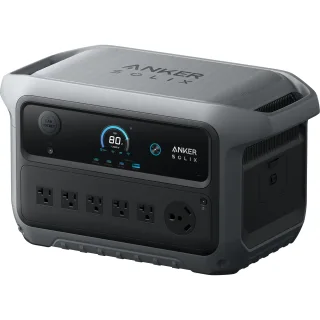
Anker SOLIX C2000 Gen 2
2,048 Wh · 2,400 W
See why Anker SOLIX C2000 Gen 2
Compare the two EcoFlow DELTA 3 Max / Anker SOLIX C2000 Gen 2
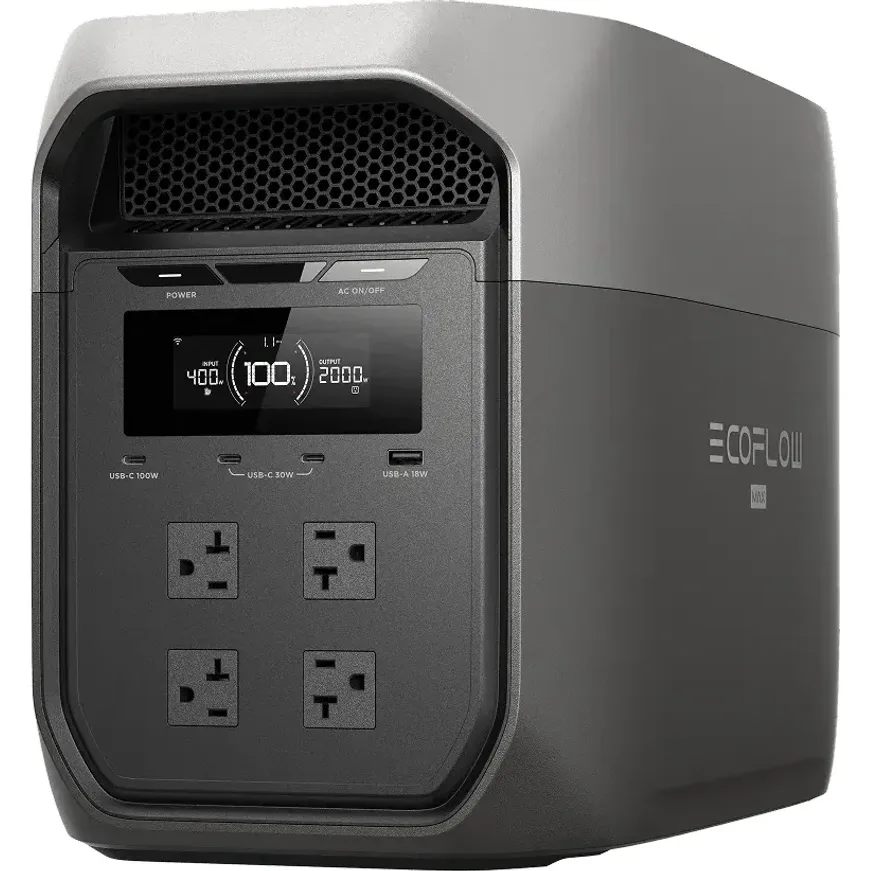
A large box. By our math it keeps a fridge, Wi-Fi and phones going for about 11 hours. At 44.8 lb, plan on two hands.
Estimates. Your devices may use more or less. One thing at a time, from a full box. We keep 85% of the watt-hours, because some power is lost on the way out.
The DELTA 3 Max and the Anker SOLIX C2000 Gen 2 hold the same: 2,048 watt-hours. Watt-hours are how much power a box holds. Both give up to 2,400 watts. Watts are how fast something uses power. What splits them is surge. Surge is a short burst some things need to start. EcoFlow lists 4,800 watts of surge for this box. Anker lists 4,000 for the C2000 Gen 2.
By our math, counting a fridge at 120 watts, Wi-Fi at 15 and phones at 20:
These are estimates. Your devices may use more or less.
A sump pump can need a burst of about 2,760 watts to start. By our math both boxes can start one; this box has more to spare. The Anker is ahead in other places. It weighs 41.7 pounds; this box, 44.8. It takes 800 watts of solar panels; this box, 500. It has 5 wall-style outlets; this box, 4. Anker also says the C2000 Gen 2 takes one extra battery.
44.8 pounds is a two-hand lift. EcoFlow says it charges from 0 to 80% in 68 minutes from the wall. EcoFlow gives no time for a full charge.
EcoFlow also lists a mode called X-Boost for up to 3,400 watts. That is a boost mode, not surge.
We're checking two things. EcoFlow gives no cycle count for this box. And EcoFlow does not say if you can add an extra battery.
The 4,800-watt surge comes from one line on EcoFlow's page, not from its spec table or manual. The warranty is 3 years, or 5 if you register the box.
Bottom line: a large box. Pick it over the Anker for the higher surge, not for solar.
Outages that last through the night. By our math it runs a fridge, Wi-Fi and phones for about 11 hours.
People who plan to charge mostly from solar panels. It takes up to 500 watts of solar; the Anker SOLIX C2000 Gen 2 takes 800.
Every number comes from the maker’s own page. If we could not confirm one, it says “We’re checking”.
| Watt-hours (how much it holds) | 2,048 Wh |
|---|---|
| Amp-hours (another way to say how much it holds) | 40 Ah at 51.2 V |
| Watts (how fast it gives power) | 2,400 W |
| Surge (short burst for start-ups) | 4,800 W |
| Weight | 44.8 lb |
| Battery type | LiFePO4 |
| Time to charge from the wall | 0-80% in 68 minutes from the wall (1,800W input). EcoFlow gives no time for a full charge. |
| Most solar it can take | 500 W |
| Wall-style outlets | 4 |
| Fastest USB-C port | 100 W |
| Switch-over time in an outage | 10 ms |
| Warranty | 3 years |
| Size | 19.4 x 9.4 x 12.0 in |
Specs last checked on October 13, 2026. See the maker’s page →
Amp-hours: by our math, 2,048 watt-hours is about 171 amp-hours at 12 volts. We divide watt-hours by volts. EcoFlow lists 40 amp-hours at 51.2 volts. It is the same power, counted another way.
Not sure it is enough? Try Find My Power Compare it with another box