Backup power for a whole home
No portable box runs a whole home: an average U.S. home uses about 30,000 watt-hours a day, and a large portable box holds about 2,000.
No portable power station runs a whole home. An average U.S. home uses about 30,000 watt-hours a day, and a large portable box holds about 2,000. Watt-hours: how much power a box holds.
What a box can do is keep a short list of must-haves on. This page shows the math, the big jobs a box cannot do, and the other kinds of backup.
The math on a whole home
The U.S. Energy Information Administration says the average home bought 10,791 kilowatt-hours of electricity in 2022. By our math that is about 29,564 watt-hours a day. Spread over the day, it is 1,232 watts around the clock. Watts: how fast something uses power.
2,073 Wh × 0.85 ÷ 1,232 W = 1.4 hours
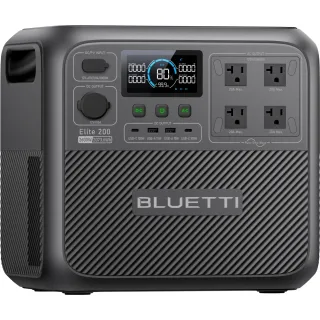
That is the BLUETTI Elite 200 V2, a large portable box, feeding an average home. It would be empty in less than two hours.
Estimates. Your devices may use more or less.
The big jobs a portable box cannot do
Some things in a home need far more watts than a portable box gives. Honda's guide also marks some of them as needing 240 volts. A normal wall outlet is 120 volts.
| Thing | Watts while running | Where the number comes from |
|---|---|---|
| Electric clothes dryer | 5,400 | Honda guide, marked 240 volts |
| Electric water heater | 4,500 | Honda guide, marked 240 volts |
| Electric range, one 8-inch burner | 2,100 | Honda guide, marked 240 volts |
| Space heater | 1,500 | Our tools |
| Microwave | 1,100 | Our tools |
| Window AC | 900 | Our tools |
| Sump pump | 800 | Our tools |
| Central air conditioner | We're checking | No source yet |
| Well pump | We're checking | No source yet |
The first three rows come from Honda's generator wattage guide. The Elite 200 V2 gives 2,600 W. That is less than the dryer or the water heater needs.
Motors also need a push to get going. Surge: a short burst some things need to start. Our tools count 2,200 watts to start a sump pump, 2,000 watts to start a window AC and 1,200 watts to start a fridge. Our guide to watts vs. watt-hours explains why both numbers matter.
Three kinds of backup
| Kind | How it connects | Good to know |
|---|---|---|
| Portable power station | You plug your things straight into it | Runs a short list for hours, then needs a charge |
| Installed home battery | It is mounted and wired into the home by an installer | Can feed whole circuits; some give 240 volts |
| Fuel generator | It runs outdoors; things plug into it, or an electrician adds a transfer switch | Runs as long as it has fuel; makes carbon monoxide |
Here is one example of an installed system. Anker says its SOLIX E10 holds 6,144 Wh per battery and gives 7,680 W at 120 and 240 volts. That is about three times the watts of the Elite 200 V2. It is not a box you carry. It is mounted and wired in.
Never feed a wall outlet
Do not plug a generator or a power station into a wall outlet to power the house. OSHA's fact sheet on generators is plain: never attach one to a building's wiring unless a qualified electrician has installed a transfer switch. OSHA says the wrong hookup can send power down the lines and can kill utility workers.
Plug your things into the box instead. This page is not wiring advice. For any work on your home's wiring, ask a licensed electrician.
Why some people choose a battery
A fuel generator makes carbon monoxide, a gas you cannot see or smell. The CPSC says more than 100 people die each year from carbon monoxide linked to portable generators. It says to never run one inside a home or garage, and to keep it at least 20 feet from the house.
A battery power station has no engine and burns no fuel. But when it is empty, it stays empty until you can charge it again.
Make an essentials list
You cannot run it all. So pick what you cannot do without.
- Write down your must-haves. A common list is a fridge, Wi-Fi, lights and phones.
- Add the watts. Our tools count 120, 15, 40 and 20. That is 195 watts.
- Leave out things that make heat. A space heater alone is 1,500 watts.
- Pick your hours. Then let Find My Power size the box.
- If someone at home uses a CPAP, read backup power for a CPAP first.
2,073 Wh × 0.85 ÷ 195 W = 9.0 hours
That count acts as if the fridge never rests, so real time can be longer. Our guide on how long a fridge runs shows why. To keep the internet up, see how to keep Wi-Fi on.
A bigger portable box stretches the list. The EcoFlow DELTA Pro 3 holds 4,096 Wh and gives 4,000 W. By our math it runs the same 195 watts for about 18 hours.
You can also compare two boxes side by side or see our picks.
Questions people ask
Can a power station run central air?
Not the portable boxes in this guide. We do not have a sourced watt number for central air yet. An installed system and a licensed electrician are the right place to ask.
How many watt-hours do I need for one day of essentials?
By our math, 195 watts for 24 hours needs about 5,506 watt-hours. That is more than two Elite 200 V2 boxes hold.
Can I plug a power station into a wall outlet to power my house?
No. Power can flow back into the lines and hurt people. Plug your things into the box, or ask a licensed electrician about a transfer switch.
Do solar panels that plug into the wall keep the lights on in an outage?
Plug-in solar: small panels that plug into a wall outlet. The state laws we read make these kits shut off when the grid is down, so they do not help in an outage on their own. Read is plug-in solar safe? for why.
Estimates. Your devices may use more or less. As an Amazon Associate I earn from qualifying purchases. Made with AI tools for research and drafting. Samuel Guerra reviews every guide and checks it against the sources linked on this page.